Wednesday, May 27, 2015

Designing a "RAFT" - World War II Performance Assessment

About midway through this semester, I decided to change things up a bit regarding the mastery progression through our course.  Up until this point, each standard had it's own stand-alone summative assessment.  After putting this system into practice, it became evident that there were some practical (and philosophical) flaws. Without going into too much detail, we decided to group multiple standards into a more comprehensive performance assessment.

My colleague Brian Germain proposed a RAFT project.  In general, students assume the role of a historical figure and have control over the following:

Role  (Ex. Arms Manufacturer, War Correspondent, FDR, Interned Japanese Citizen)
Audience (Ex. American Soldier, Military Recruiter, WWI Veteran, Self)
Format (Ex. Propaganda Poster, Letter, Political Cartoon, Radio Speech, Military Field Guide)
Topic (Ex. Wartime Industry, Pearl Harbor, Scientific Research, Ending Segregated Units)

Click here to view the entire World War II RAFT performance assessment guide.

Their final "product" depended upon the format they chose.  For instance, it may be a letter, poster, audio file, etc.  

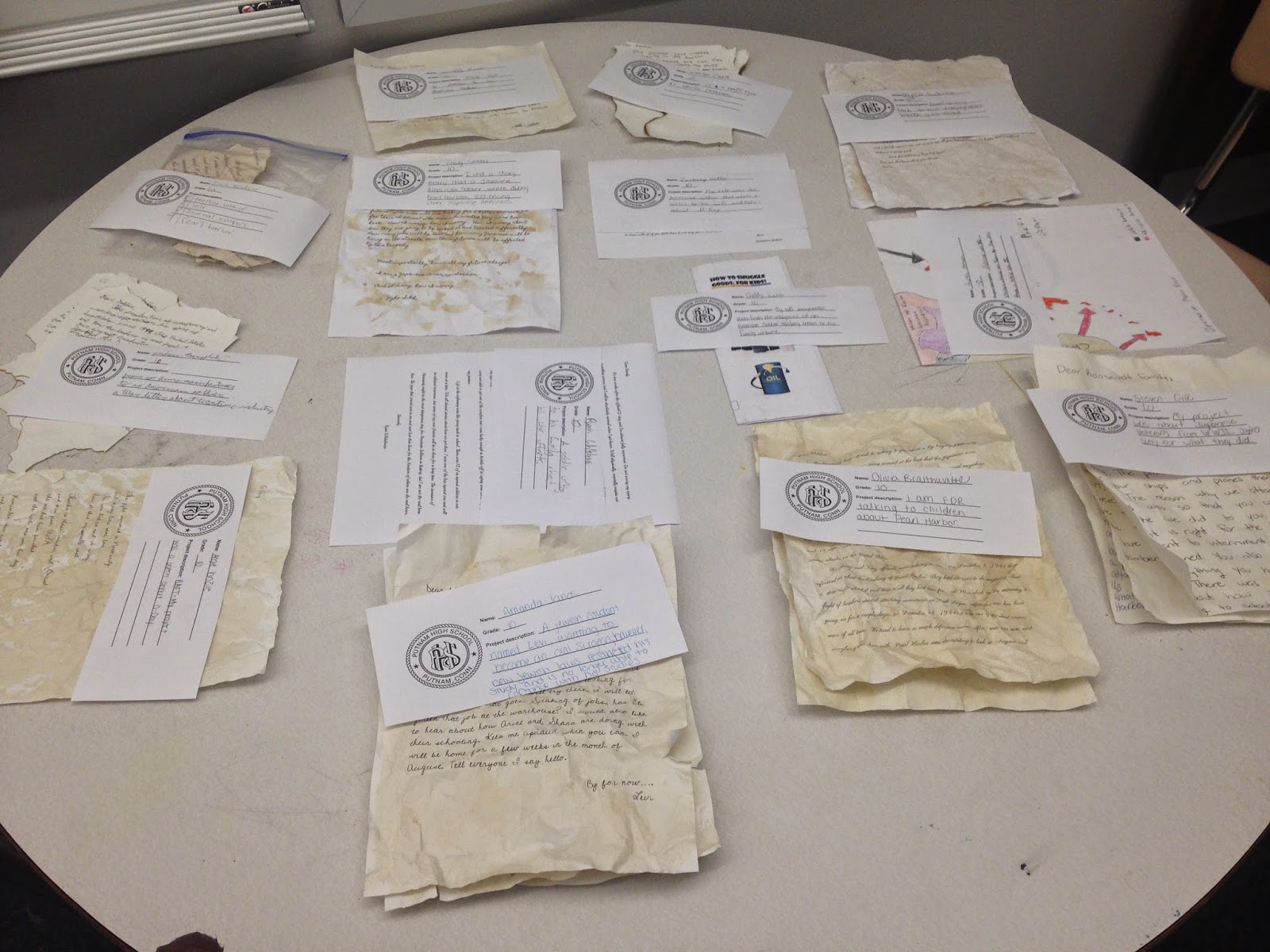
We also tried to make the war letters and journal entries look more authentic by using techniques that make paper look old.   In the photo to the right, you can see how students were actually using tea to create this effect.

Since there were many different phases to the project, we created this template to help guide students through the process.  It included specific steps to take while also proving some graphic organizers.  Sharing this document back with us also helped Brian and I track students' progress and provide feedback and support when needed.

As for grading, the following four standards were tagged to this one performance assessment:
Craft & Structure: Comparing Points of View
Research: Selecting Relevant Sources
Research:  Conducting Sustained Research Projects
Speaking: Integrate Sources & Present in Diverse Formats

Overall, I feel that students not only enjoyed this performance task, but were better able to demonstrate proficiency in the skills since the task was much more authentic.  Students also commented that they enjoyed how much choice they had when designing the final product.

When I work on redesigning the mastery progression for next year's course, I will develop more of these performance tasks that enable students to grapple with the content in more authentic ways while also providing them with opportunities to demonstrate mastery of multiple standards in a single project.

Thursday, April 2, 2015

Flipped Learning Toolkit

Jon Bergmann & Aaron Sams (pioneers of the flipped classroom) recently teamed up with Edutopia to create the Flipped Learning Toolkit.  This is an excellent collection of videos and articles designed for both those new to Flipped Learning as well as more experienced educators and administrators.

If you are interested in Flipped Learning and would like to sharing the concept with other educators and stakeholders in your community, I highly suggest checking out this series.

Click here to see the entire collection on Edutopia.

The 6 videos in this series can also be viewed below:

Rethinking Space & Time


Overcoming Common Hurdles


Is Flipping For Everyone?


Formative Assessment


Which Tech Tools Are Right For You?


Getting Stakeholders On Board

Sunday, March 29, 2015

Mastery Learning Research & Case Studies

Starting next fall, our social studies department is rolling out a true mastery (competency-based) learning system across all core subjects and grade levels.  As I've mentioned in prior posts, our pilot this spring has led us to realize how much planning and preparation is needed to effectively implement this approach.  Before nailing down all of the logistical details for 2015-2016, we have decided to revisit the research on mastery learning and standards-based grading. We will also find and evaluate several case studies of effective implementation throughout the country.   

Since many of you may be considering a shift towards mastery learning and/or standards-based grading in the future, I am sharing out our Google Drive folder containing research and resources.  We will be adding more that we find pertinent and useful over the next several months.

Click here to view the "Mastery Learning / SBG Resource Folder"

*** If you come across any other research and resources that you think would be helpful, please share and it will be added to the collection!

Friday, March 20, 2015

Student Progress Monitoring With Google Doc Portfolios

Through my research and classroom experience, I've realized how critical progress monitoring is for students, particularly when they are engaged in mastery learning.  When I first attempted to tackle progress monitoring, it was focused more on the daily routine and classroom management.  This year I have realized that students need a more robust and consistent form of progress monitoring if they are to effectively gauge their skill level and track their progression through the course.

I have actually chosen a rather simple way to have students do this: a Google doc.

Yes, there are digital portfolio platforms and standards-based grading software, but for our purposes, a simple Google Doc helps students set goals, organize their evidence, track progress and reflect upon their learning experiences.

Here is the format for the students' portfolios:
-----------------------------------------------------------------------------
Standard # __ :   [Insert standard description here...]

Evidence:  [Link / describe evidence of proficiency here...]

Reflection:  [What was difficult?  What was easy?  What learning strategies did you use?  What goals will you set moving forward? What feedback do you have for Mr. Driscoll?] 
-----------------------------------------------------------------------------

Below you can see a screenshot from one student's portfolio: 


Another advantage of this is that I can easily access each student's portfolio document through a spreadsheet (via form submission - see screenshot to the right) and provide them with commentary and feedback throughout the semester. This has particularly helped when students start to fall behind.  For example, we just had parent-teacher conferences and I was able to go through each student's portfolio with parents to discuss progress (or lack thereof) and discuss strategies to help get them back on track.

Although this has been a very helpful way for students to organize their evidence and track their progress, I need to rethink how we should approach each unit reflection.  Results on this front have been less than stellar,  more on that next week...

Friday, March 13, 2015

Flipped Mastery Presentation from #HIBLC15

Last Saturday marked the Highlander Institute's 4th Annual Blended Learning Conference in Providence, RI.  At the conference, I had the opportunity to lead a session on "Flipped Mastery."  Embedded below (and linked here) is the slide deck from my presentation. 

I also curated a list of resources for participants about Mastery and Flipped Learning which can be accessed below or at bit.ly/masteryresources.  Feel free to share these resources with anyone you think may be interested. And as always, contact me with any questions you may have about flipping or mastery (competency-based) learning!


FLIPPED MASTERY RESOURCES

VIDEOS
Flipped-Mastery Classroom
Quick Guide to Flipping Your Class
6 Inspiring Videos About Flipped Learning
Student Perspectives on Mastery Learning
Mastery Learning in Action (BETTER LESSON)
Flipped Mastery in Social Studies

ARTICLES
In Flipped Classrooms, a Method for Mastery (New York Times 10/2013)
New Hampshire’s Journey Towards Competency-Based Education
Making Mastery Work: Executive Summary (Nellie Mae Education Foundation)
Advice for School Principals on Implementing Competency Education
5 Myths About Mastery-Based Learning (Newton)
Blending Toward Competency (Christensen Institute)
Our Transition to Standards-based Grading (Essex Middle School, NH)
What is Flipped Learning? (Flipped Learning Network)

FLIPPED & MASTERY LEARNING BOOKS
Flip Your Class: Reach Every Student in Every Class Every Day
Flipping 2.0: Practical Strategies for Flipping Your Class
Flipped Learning: Gateway to Student Engagement
Formative Assessment & Standards Based Grading

CREATING INSTRUCTIONAL VIDEOS
Creating Instructional Videos Guide
Video Samples From Various Grade-Levels / Disciplines
Flipped History Videos (Tom’s YouTube Channel)
How to Watch Instructional Videos (Tutorial for Students by PHS Social Studies Dept.)
Screencast-O-Matic Tutorial: Screenshot Version (Doc) / Video Version
Snagit Chrome App Tutorial: Snagit Chrome App Walk-Through

Go-To Screencasting Options By Device
PC / MAC
iPAD
Chrome / Chromebook
302526_254938864548025_2055962132_a.jpg


05_06_CamtasiaLogo.gif
educreations_logo_1.png


7021044_orig.png
Explain Everything
images


app-icon-snagit.png
Snagit

COMMUNITIES
Flipped Learning Network (Professional Learning Community)
Flipped Social Studies Community Doc

FLIPPED LEARNING RESEARCH
Flipped Learning Network Research Page
Flipped Learning Literature Review
Flipped Learning & Democratic Education (Columbia University MA Research 12/2012

FLIPPING SOCIAL STUDIES ARTICLES
Empowering Students Through Flipped Learning (SmartBlog on Education 1/2014)
Not Just Flipped (EdTech Digest (12/2013)
Flipping Social Studies (CUE Blog 10/2013)